
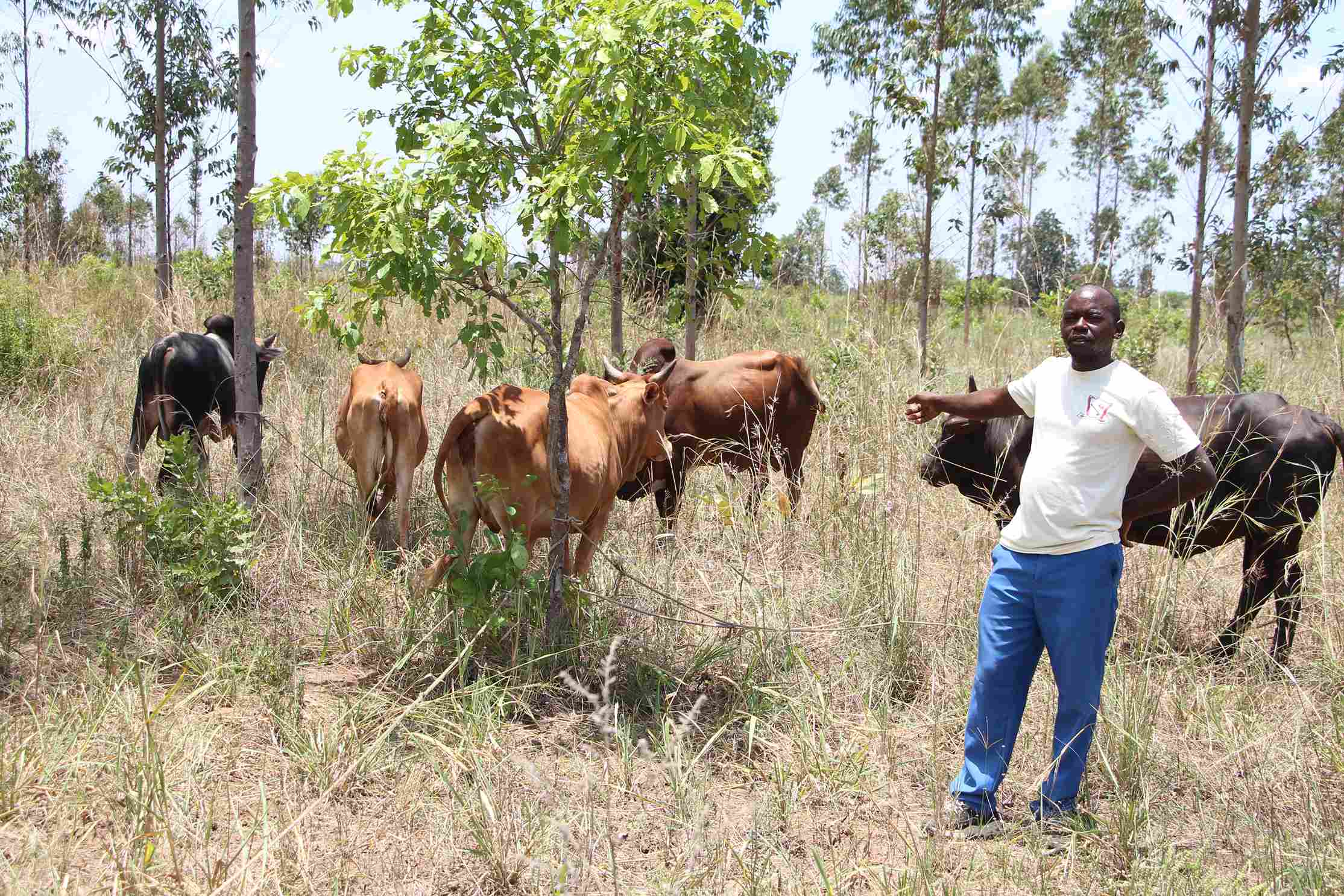
In Akileng Parish, Alito Central Village in Alito Sub County, Kapelebyong District, the story of Denis Omara, a 34-year-old smallholder farmer, reflects how knowledge, determination, and targeted project support can transform livelihoods.
Born in 1992, Omara grew up in a rural farming household where survival depended largely on small-scale agriculture. However, life was not easy. Due to financial hardships, Omara could only study up to Primary Seven before he was forced to drop out of school.
“When I joined Primary Seven, the situation at home became very difficult and I had to return home,” Omara recalls.
After leaving school, he stayed at home for about two years before marrying his wife, Akao Dorcus. Together, they started a family and are now raising seven children. Like many young families in rural communities, Omara struggled to provide for his growing household.
Before receiving support through the ADEFO–MAP project implemented by SOCADIDO, Omara’ life was marked by uncertainty and poverty. His small farming activities generated very little income, barely enough to feed his family. Paying school fees and meeting basic needs such as healthcare was extremely difficult.
“Before the organization came, my situation was bad. I was among the less privileged and I even started wondering if God had chosen me to be among the poor,” he says.
The little farming he practiced was mainly subsistence-based, and without proper training, improved inputs, or business knowledge, Omara found it difficult to make progress. His children’s education was often interrupted due to lack of school fees, and opportunities to improve his household income seemed limited.
Everything began to change when SOCADIDO, through the ADEFO–MAP2 project, introduced training and capacity-building activities in the community. The project, implemented over 36 months from December 2021 to February 2025, supports farmers across Kaberamaido, Kapelebyong, Katakwi, Ngora, Soroti Districts and Soroti City, reaching 3,600 households and more than 21,000 direct beneficiaries.
Omara eagerly participated in the training sessions. “When the organization came, they started training us on agriculture, business and other skills. I took up the message seriously,” he explains.
Through the training, Omara learned improved farming techniques, business management skills, and the importance of diversification. Motivated by the knowledge he acquired, he began to transform his farming activities into a small agribusiness.
Within the first year, Omara began seeing results. “I started engaging seriously in farming and later turned it into a business. Within that one year I managed to buy my first plot of land,” he says proudly.
Encouraged by this progress, Omara continued expanding his activities. In the second year, he managed to construct a house on his plot of land, a major milestone for his family. His improved income also enabled him to provide better education opportunities for his children.
“I have managed to take my children to private school in Katakwi,” he says.
Today, Omara has diversified his livelihood and invested in several income-generating activities. He runs a poultry project with about 100 chickens and has expanded into livestock farming, where he now owns six cows. What began as small subsistence farming has grown into a thriving rural enterprise.
Omara estimates that the assets he has accumulated since joining the project are significant. “If I calculate the assets I have gained since the organization came, they are now worth about 100 million shillings,” he says.
Beyond personal success, Omara has also become active in community development. Together with other community members, he joined a savings group in Akileng Parish, which later evolved into a cooperative society. Members contributed funds to formally register the cooperative at both the sub-county and district levels.
Currently, the cooperative operates from a temporary space provided by Omara himself.
“We wanted government and civil society organizations to know that we are organized and registered in Alito Sub County,” Omara explains. “Where the cooperative is operating now is part of my house. I gave one of my front rooms so that we can start somewhere,” he says.
Omara believes more support could help farmers in the area grow even further. He appeals for additional assistance, including storage facilities, transport, tarpaulins for drying produce during rainy seasons, and stronger linkages with agricultural input dealers.
Looking back at his journey, Omara is grateful for the transformation he has experienced.
“I want to say I am happy with the coming of SOCADIDO. If they had not come, our lives would not have changed,” he says.
Omara’ story stands as a powerful example of how knowledge, opportunity, and determination can help rural farmers break the cycle of poverty and build a more secure future for their families.